
A chiller fails its factory performance test. The unit is fully charged, the test bay is occupied, and production has a schedule to keep. Before anyone can open a valve, pull a compressor, or swap a component, hundreds of pounds of refrigerant need to go somewhere. That “somewhere” and what happens to the refrigerant afterward is the subject worth examining here.
Data-center chillers carry substantial refrigerant charges, and the OEM production cycle (charging, testing, troubleshooting, repairing, retesting) can require removing and managing that refrigerant multiple times before a unit ever ships. By the end of this article, you’ll have a clear picture of where recovery and recycling fit into that production workflow, what the real friction points are, and what to evaluate when selecting equipment for the job.
Who this applies to
This is written for chiller OEM production teams, test engineers, manufacturing engineers, and plant managers who deal with refrigerant as part of building and validating equipment, not servicing it in the field. If your primary concern is residential HVAC maintenance or end-of-life disposal of small split systems, this isn’t the right resource.
The discussion is most relevant where large refrigerant charges, repeated test cycles, multiple refrigerant platforms, or rework loops create real volume and logistics challenges around refrigerant handling.
Why refrigerant recovery matters during chiller manufacturing
Recovery is typically associated with field service or decommissioning. In an OEM production environment, the need is different. Chillers built for data-center applications can contain significant quantities of refrigerant. When a unit doesn’t pass its factory performance test, or when a modification is required mid-production, that charge has to come out before any mechanical work begins.
The U.S. EPA’s Section 608 regulations require that refrigerant be recovered from appliances before they are opened for service or repair. EPA specifies that small-appliance recovery equipment must recover 90% of refrigerant when the compressor is functional, or 80% when it is not. For stationary equipment like large chillers, the recovery requirements and equipment certification standards apply regardless of whether the work happens in the field or on a factory floor.
So recovery isn’t optional, and it isn’t occasional. On a production line running multiple units through test bays, it can be a recurring step.
Where recovery fits into the OEM production process
One way to think about it: an OEM production and test workflow might follow a sequence like Charge, Test, Identify Issue, Recover, Repair or Modify, Recycle or Process, Recharge, Retest.
→
Test
→
Identify issue
→
Recover
→
Repair / modify
→
Recycle / process
→
Recharge
→
Retest
Not every manufacturer follows this exact path. But the pattern illustrates where recovery becomes a production activity rather than a maintenance activity. Each stage carries its own engineering considerations.
Charging involves getting the correct refrigerant type and quantity into the system. Testing validates performance. When testing identifies a problem (a leak, a compressor issue, a controls fault), the refrigerant must be recovered before the system can be opened. After the repair or modification, the recovered refrigerant may be recycled and reused for the recharge, and the unit goes back through testing.
The critical point: in a production environment, this loop can repeat. A single chiller might go through charge-test-recover-repair-recharge-retest more than once before it ships. That makes recovery throughput and refrigerant reuse directly relevant to production efficiency.
Recovering refrigerant after factory testing
An OEM may need to recover refrigerant before component replacement, system modification, refrigerant changeover, or simply to allow additional diagnostic access. Each recovery event requires proper segregation. Recovered refrigerant should go into dedicated recovery cylinders labeled for the specific refrigerant type, and cylinder weight should be recorded before and after the transfer.
This sounds straightforward. In practice, the process failures are where things break down. Mislabeled cylinders, undocumented transfers, and mixed refrigerants are common problems that show up across production environments. A cylinder contaminated with the wrong refrigerant is essentially downgraded inventory. The U.S. EPA restricts the transfer of recovered refrigerant to a new owner unless it has been reclaimed to AHRI Standard 700 purity specifications by an EPA-certified reclaimer. So contamination doesn’t just waste material; it creates a disposal and compliance problem.
Why high-capacity recovery equipment matters for large chillers
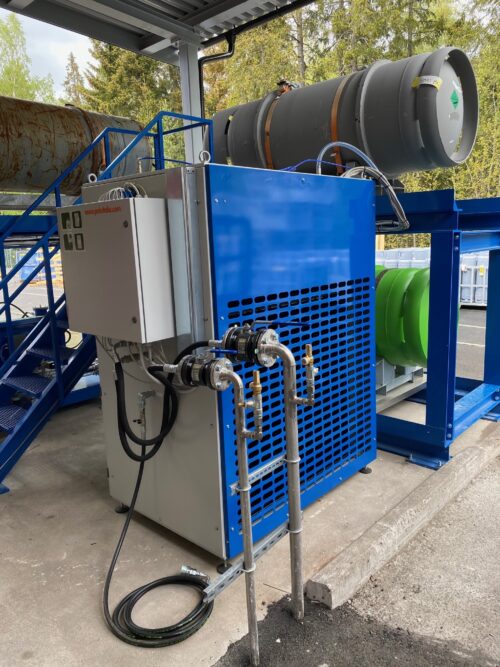
A portable recovery unit designed for light commercial work will struggle with the charge volumes found in data-center chillers. The mismatch shows up as extended recovery times, which means the test bay is occupied longer and production throughput drops.
Industrial recovery systems for chiller OEM applications need to be designed around the actual refrigerant charge sizes, the liquid and vapor recovery requirements of the specific refrigerants being handled, the pace of production, and the need for repeated recovery cycles. Integration with the broader production process (evacuation, charging, testing) also matters. A recovery system that operates as a standalone island, disconnected from the rest of the test workflow, adds handling steps and transition time.
The refrigerant type itself affects equipment selection. Different refrigerants have different operating pressures, vapor densities, and compatibility requirements. Equipment designed for one refrigerant family may not be appropriate for another, and as OEMs produce chillers using A2L and other lower-GWP refrigerants, the recovery equipment has to match.
Recovery, recycling, and reclamation are not the same thing
This distinction matters, and getting it wrong creates compliance risk.
Recovery
Removing refrigerant from a system and storing it in an external container. No processing or testing is required.
Recycling
Cleaning recovered refrigerant (typically through oil separation, moisture removal, and filtration) for reuse within equipment owned by the same entity.
Reclamation
A more rigorous process: reprocessing refrigerant to meet AHRI Standard 700 purity specifications, with analytical verification, performed by an EPA-certified reclaimer.
For OEM production, recovery and recycling are the relevant processes. A manufacturer recovering refrigerant from its own chiller during factory testing and recycling it for reuse in the same or another unit on the same production line is operating within the same-owner reuse framework. Reclamation becomes relevant when refrigerant changes ownership or when contamination levels exceed what recycling can address.
Refrigerant recycling after recovery
Recycling allows recovered refrigerant to be processed and returned to use within the OEM’s own production workflow. The recycling process can address contaminants such as compressor oil, moisture, particulate matter, and acidity, depending on the equipment configuration and the specific contaminants present.
The key qualifier: recycling does not guarantee that every contaminant is removed to every specification. The effectiveness depends on the filter-driers, oil separation capability, and process design of the recycling equipment. Recovered refrigerant that has been heavily contaminated (from a compressor burnout, for example) may not be recoverable through recycling alone and may need to go to an EPA-certified reclaimer or be handled as waste.
In-house recycling reduces the cost and logistics of shipping recovered refrigerant to an external facility and gives the OEM tighter control over refrigerant inventory. That’s a meaningful advantage when production volumes mean frequent recovery events.
Managing multiple refrigerants and reducing cross-contamination risk
OEMs producing chillers across multiple product platforms may work with several refrigerant types. Each refrigerant requires its own dedicated recovery cylinders, and the recovery process itself needs to be designed to prevent cross-contamination.
Mixing refrigerants in a recovery cylinder is one of the most common and most expensive process errors in refrigerant management. Once mixed, the cylinder’s contents are difficult to separate and typically must be sent to a reclaimer or disposed of at a loss. Proper labeling, cylinder segregation, and clear procedures for refrigerant changeovers (when switching a test bay from one refrigerant type to another) are the practical controls.
The shift toward lower-GWP refrigerants
The industry transition toward lower-GWP refrigerants makes recovery and recycling practices more relevant, not less. The U.S. EPA’s technology transitions rule under the AIM Act establishes GWP limits for specific applications and sectors, with different effective dates depending on the end use. For new stationary refrigeration and air conditioning equipment, these requirements are phased in over time.
Lower-GWP refrigerants, including many A2L-classified options, may have different handling requirements, flammability considerations, and equipment compatibility needs. Recovery and recycling equipment designed for legacy high-GWP refrigerants may not be suitable. OEMs transitioning their product lines need to evaluate whether their refrigerant management infrastructure can handle the new refrigerants.
Transitioning to A2L or lower-GWP refrigerants?
VTech engineers recovery, recycling, evacuation, and charging equipment matched to the specific refrigerants your production line handles. Scope a system around your requirements.
The real friction points
| Problem | The practical fix | Why it keeps happening |
|---|---|---|
| Recovery cylinder rejected by reclaimer | Segregate by refrigerant type immediately; quarantine suspect cylinders | Mislabeling during multi-refrigerant changeovers |
| Recovered refrigerant fails reuse check | Run through oil separation and replace filter-driers before reuse | Assumption that recovery equals ready-to-reuse |
| Test bay delays during chiller teardown | Size recovery equipment for stationary refrigeration loads, not light commercial | Equipment spec’d for the wrong application |
| Audit gaps in refrigerant disposition | Treat every recovery as a chain-of-custody event with weights and signatures | Documentation treated as optional |
| Recovered charge downgraded to waste | Isolate the batch and route to an EPA-certified reclaimer | Wrong refrigerant mixed into the cylinder |
Where practitioners disagree
There’s an ongoing debate about how aggressively OEMs should invest in in-house recycling versus simply recovering and sending material out for third-party reclamation. Some production engineers argue that the capital cost and maintenance burden of in-house recycling equipment isn’t justified unless recovery volumes are consistently high. Others point to the logistics delays and per-pound costs of external reclamation as a drag on production flexibility. I lean toward in-house recycling for any OEM running frequent test-recover-retest cycles on large-charge equipment, because the production time saved tends to outweigh the equipment investment. But the math depends on volume, refrigerant type, and how often recovered material actually needs processing beyond basic filtration.
Building recovery and recycling into the chiller test process
Recovery and recycling work best when they’re integrated with evacuation and refrigerant charging as part of a unified production system. Treating each function as a separate, disconnected operation introduces handling steps, increases the chance of contamination or documentation gaps, and slows the charge-test-recover-recharge cycle.
Integrated process equipment that handles evacuation, charging, recovery, and recycling within a coordinated workflow gives production teams a shorter path from “failed test” back to “retest.” It also simplifies refrigerant inventory tracking, since material flows through a defined system rather than moving between disconnected stations.
What to evaluate when selecting a recovery and recycling system
Nine practical considerations, in no particular priority order (because priority depends on your operation):
Production benefits worth defending
Integrated recovery and recycling in an OEM production environment can reduce unnecessary refrigerant consumption by enabling reuse of suitable recovered material. It can reduce logistics costs associated with external recycling or reclamation. It supports repeated testing cycles without requiring fresh refrigerant for every charge event. And it gives the OEM better control over refrigerant inventory and documentation.
Those are defensible, practical outcomes. They scale with production volume and charge size.
Integrating recovery into the production workflow
Refrigerant recovery and recycling sit inside the production workflow for data-center chiller OEMs, not alongside it. The next problem most teams hit after recognizing this is figuring out how to integrate recovery, recycling, evacuation, and charging without bolting together disconnected equipment from four vendors.
Turnkey refrigerant management for chiller OEMs
VTech Process Equipment provides turnkey refrigerant management systems for chiller OEM production environments, integrating evacuation, charging, recovery, and recycling into a coordinated production workflow. If you’re evaluating how to build or upgrade that infrastructure, reach out to VTech’s engineering team to scope the conversation around your specific production requirements.
Frequently asked questions
Is refrigerant recovery the same as recycling?
No. Recovery means removing refrigerant from a system and storing it in an external container without processing it. Recycling means cleaning that recovered refrigerant (through oil separation, filtration, and moisture removal) for reuse within equipment owned by the same entity. Reclamation is a separate, more rigorous process performed by an EPA-certified reclaimer to restore refrigerant to AHRI Standard 700 purity specifications, typically required when refrigerant changes ownership.
When does a chiller OEM actually need to recover refrigerant during production?
Any time a charged system needs to be opened. Failed performance tests, component replacements, leak repairs, controls modifications, refrigerant changeovers. On large data-center chillers with substantial charges, this can happen more than once per unit before it ships.
Why does refrigerant segregation matter so much in an OEM environment?
Because OEMs often produce chillers using different refrigerants across product platforms. A single mixed cylinder can’t be easily separated, and the EPA restricts transferring recovered refrigerant to a new owner unless it has been reclaimed. Mixing turns usable inventory into a disposal problem.
Is in-house recycling worth the investment for a chiller OEM?
It depends on recovery volume and how frequently the test-recover-retest loop runs. For OEMs with high-volume production of large-charge chillers, the reduction in external logistics costs and production delays typically justifies the equipment. For lower-volume operations, the calculus is less clear, and external reclamation may be more practical.