

Highly engineered HVAC systems like large data-center chillers may utilize multiple refrigerants to achieve optimum system performance. That single reality reshapes what OEMs need from their charging equipment. A standard evacuation-and-fill cycle handles one refrigerant, one recipe, one workflow. Multi-refrigerant charging demands something broader: the ability to balance speed, accuracy, repeatability, refrigerant verification, safety, and integration with the rest of the production process, all without slowing the line.
By the end of this article, you’ll understand what separates multi-refrigerant charging from conventional single-refrigerant filling, and you’ll have a practical framework for evaluating charging equipment against your production requirements.
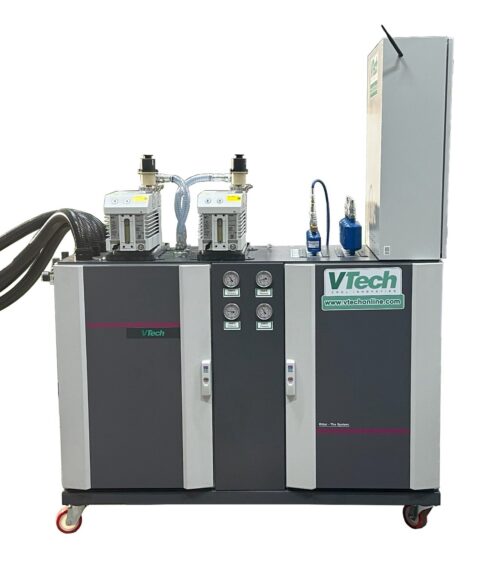
Why multi-refrigerant charging matters for chiller OEMs
The production problem is straightforward to describe and difficult to solve. When a facility manufactures chillers that ship with different refrigerants (or different refrigerant configurations within the same product family), the charging process must accommodate each one without introducing variation, contamination risk, or operator confusion.
That means the charging system needs to handle programmable refrigerant ratios, manage production recipes that differ from unit to unit, and verify that the refrigerant being charged actually matches the recipe loaded for that specific unit. Cross-contamination between refrigerant types during production can create rework, scrap, and testing delays that ripple through the schedule.
Production flexibility is the core driver here. An OEM running a mixed-model line can’t afford a charging process that requires extensive manual reconfiguration between units. The refrigerant charging system needs to integrate with evacuation, support recipe changeover, and deliver repeatable results across every refrigerant the production program requires.
What makes chiller refrigerant charging different
Chiller charging at OEM scale differs from residential or light-commercial charging in ways that aren’t always obvious from the outside.
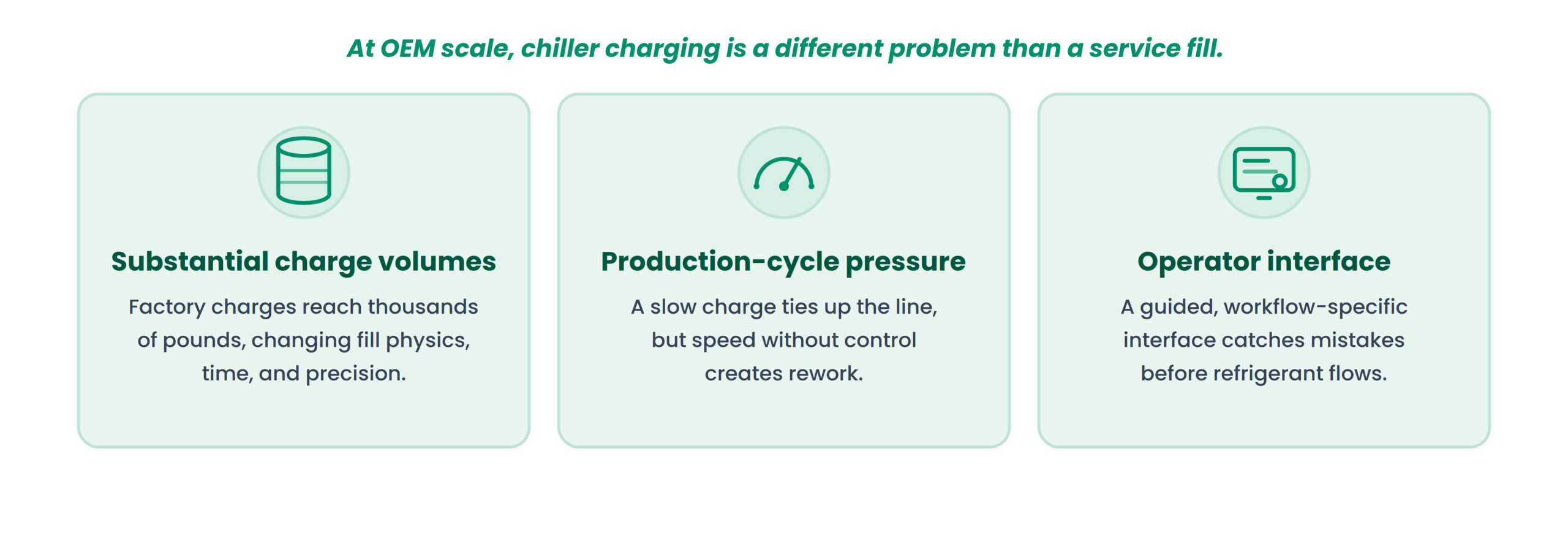
The charge quantities can be substantial. Some air-cooled data-center chiller models carry factory charges measured in thousands of pounds of refrigerant. That volume changes the physics of the fill process, the time required, and the precision needed to hit target charge within acceptable tolerances.
Then there’s the production-cycle constraint. A chiller sitting on the line waiting for a slow charge is consuming floor space, tying up downstream test stations, and delaying shipment. But speed without control creates its own problems: inconsistent charges, missed verification steps, potential rework after testing.
The operator interface is also a key factor. When a technician loads a recipe, connects charging lines, and initiates the fill, the system’s ability to guide that interaction (and catch mistakes before refrigerant flows) determines whether the process is robustness. A customized operator interface, designed around the specific production workflow, reduces the cognitive load on the operator and shrinks the window for error.
High-speed charging with precise process control
Speed and control exist in tension on every production line. The instinct is to maximize fill rate. The reality is that charging speed only helps throughput when the process remains controlled and repeatable.
VTech’s client-supplied positioning describes this as “very high, precisely controlled filling speeds to minimize production cycle time.” That phrasing is deliberate. The filling speed is high, but it’s precisely controlled. Those two things aren’t the same, and treating them as interchangeable leads to bad equipment decisions.
What does controlled high-speed charging actually require? Metering technology that can deliver refrigerant at production-relevant flow rates while maintaining charge accuracy. Control logic that adjusts the fill process based on real-time conditions rather than simply opening a valve. And a system architecture that doesn’t sacrifice repeatability when running at speed.
The tradeoff every production engineer faces: a faster charge cycle that produces inconsistent results costs more in rework and testing than a slightly slower cycle that hits target every time.
Recipe-to-refrigerant verification helps prevent charging errors
This is where multi-refrigerant charging gets genuinely interesting from a process-control perspective.
Automatic recipe-to-refrigerant verification means the charging system can help identify a mismatch between the production recipe loaded for a given unit and the refrigerant actually connected to the system. If an operator loads a recipe calling for one refrigerant but the supply lines are connected to a different one, the verification function flags the discrepancy before charging begins.
Why does this matter so much? Because the consequences of charging the wrong refrigerant into a chiller aren’t just “add more of the right one.” An incorrect charge can mean full recovery of the wrong refrigerant, re-evacuation, potential contamination of internal system surfaces, additional leak testing, and the associated production delay. On a high-value data-center chiller, that rework cycle is expensive in time, material, and opportunity cost.
The verification concept is simple. The execution requires that the charging system can identify what’s connected and compare it against what’s programmed. Our approach to this uses automatic recipe-to-refrigerant verification as a production safeguard, though the specific identification technology isn’t detailed in published materials.
Accuracy and repeatability across multiple refrigerants
These two concepts get lumped together constantly, but they describe different things and create different production problems when they’re missing.
Accuracy
Accuracy is how closely the delivered charge matches the required charge. If the recipe calls for a specific quantity and the system delivers that quantity within its specified tolerance, the charge is accurate.
Repeatability
Repeatability is how consistently the system reproduces that result across production units. A system can be accurate on one unit and wildly inconsistent across a hundred. For OEM production, repeatability matters as much as accuracy because it determines whether every chiller leaving the line meets the same performance baseline.
When a production line handles multiple refrigerants, maintaining both accuracy and repeatability becomes harder. Different refrigerants have different densities, vapor pressures, and flow characteristics. The metering and control system needs to account for these differences rather than treating every refrigerant identically.
Flexible system configuration for chiller production
Chiller production lines aren’t identical. The charging equipment needs to adapt to the production process, not the other way around.
Depending on application requirements, VTech systems can be configured with one-sided or two-sided evacuation and filling, programmable refrigerant ratios, and customized operator interfaces. Two-sided configurations can reduce cycle time on larger systems by evacuating and filling from both sides simultaneously. Programmable ratios matter when the production program includes units with different refrigerant specifications.
The operator interface piece deserves particular attention. A well-designed interface reduces training time, minimizes operator decision points, and creates a consistent interaction pattern regardless of which recipe is running. When the interface is customized around a specific manufacturer’s workflow, operators spend less time navigating menus and more time running production.
Safety considerations for A2L and other refrigerants
An important clarification before discussing safety: A2L is a refrigerant safety classification, not a synonym for “low GWP.” The U.S. EPA distinguishes A2L as a classification associated with mild flammability, and it’s separate from a refrigerant’s global warming potential. Some low-GWP refrigerants carry an A2L classification. Others don’t. Treating these terms as interchangeable leads to incorrect equipment specifications and process design.
A2L refrigerants introduce additional flammability considerations that production equipment and facility processes must address. The EPA notes that refrigerant risks can include toxicity, flammability, asphyxiation, and physical hazards, and that engineering controls and other techniques are used to mitigate those risks.
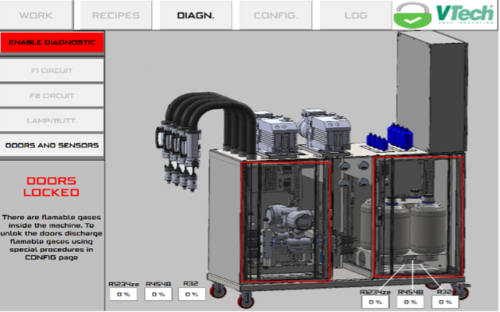
For OEM production, this means the charging equipment itself needs to be designed around the characteristics of the refrigerants being handled. VTech’s A2L refrigerant charging systems are engineered for operation with flammable refrigerants including among others R32, R452, and R454 variants, with safety features appropriate to those refrigerant classifications.
Multi-refrigerant charging as part of a broader refrigerant management process
Charging isn’t an island. In a chiller production environment, it sits within a sequence that can include pre-evacuation, evacuation, oil charging, refrigerant charging, testing, recovery, recycling, and reuse.
→
Evacuation
→
Oil charging
→
Refrigerant charging
→
Testing
→
Recovery
→
Recycling
→
Reuse
That broader process is where our positioning gets particularly relevant. Their approach integrates evacuation, oil charging, multi-refrigerant charging, recovery, and recycling into a connected production workflow. The exact configuration depend on the application, but the concept is that refrigerant management across the entire production and testing cycle can be handled as a coordinated system rather than a collection of standalone operations.
For a deeper look at the recovery and recycling side of this process, our companion article on refrigerant recovery and recycling for data center chillers covers that portion of the workflow in detail.
What chiller OEMs should look for in a multi-refrigerant charging system
A practical evaluation framework, organized by the questions that matter most in production:
No single item on this list is sufficient by itself. The value is in how many of these requirements a system addresses without requiring workarounds.
VTech’s approach to refrigerant management for chiller OEMs
VTech Process Equipment LLC provides refrigerant charging and related process equipment for HVAC/R OEM applications, including custom-engineered systems configured around specific production requirements.
Their multi-refrigerant charging systems address the capabilities outlined throughout this article: high-speed controlled charging, recipe-to-refrigerant verification, configurable evacuation and filling, programmable refrigerant ratios, and safety features for A2L and other refrigerant classifications. VTech also provides industrial recovery systems that connect charging with the downstream recovery and recycling process.
The positioning VTech wants OEMs to understand: they manage refrigerant throughout the chiller production and testing cycle, from evacuation and charging through recovery, recycling, and reuse.
Conclusion
For data-center chiller OEMs, multi-refrigerant charging is one piece of a broader production-control challenge. The right system balances accuracy, repeatability, throughput, verification, and safety while integrating with the rest of the refrigerant-management workflow.
The next problem most OEMs hit after selecting charging equipment is figuring out how it connects with evacuation and recovery on their specific line. That integration question is worth addressing early in the evaluation process, not after the equipment arrives.
Discuss your chiller refrigerant management requirements
VTech can help OEMs evaluate refrigerant charging, evacuation, recovery, recycling, and related process-equipment requirements for their production applications.
Frequently asked questions
What is multi-refrigerant charging?
Multi-refrigerant charging is a production process in which a single charging system can deliver different refrigerants (or different refrigerant configurations) to units on the same production line, managing recipe selection, refrigerant verification, and charge delivery for each configuration.
Why would a chiller OEM need multi-refrigerant charging capability?
When a production program includes chillers that ship with different refrigerants or different refrigerant ratios, the charging equipment needs to handle those variations without manual reconfiguration that slows throughput or introduces error risk.
Why is refrigerant verification important during production charging?
Charging the wrong refrigerant into a chiller can require full recovery, re-evacuation, and retesting. Automatic recipe-to-refrigerant verification helps catch mismatches before refrigerant flows, avoiding costly rework and production delays.
What’s the difference between charging accuracy and repeatability?
Accuracy measures how closely a single charge matches the target quantity. Repeatability measures how consistently that result is reproduced across multiple units. Both matter in OEM production, but they fail independently: a system can be accurate once and inconsistent across a shift.
What safety considerations apply when charging A2L refrigerants?
A2L is a safety classification indicating lower flammability. It is not synonymous with “low GWP.” Charging equipment handling A2L refrigerants needs design features that address flammability considerations, consistent with the refrigerant’s classification and applicable facility requirements. The U.S. EPA and NFPA provide guidance on refrigerant safety classifications and associated risk-mitigation approaches.