
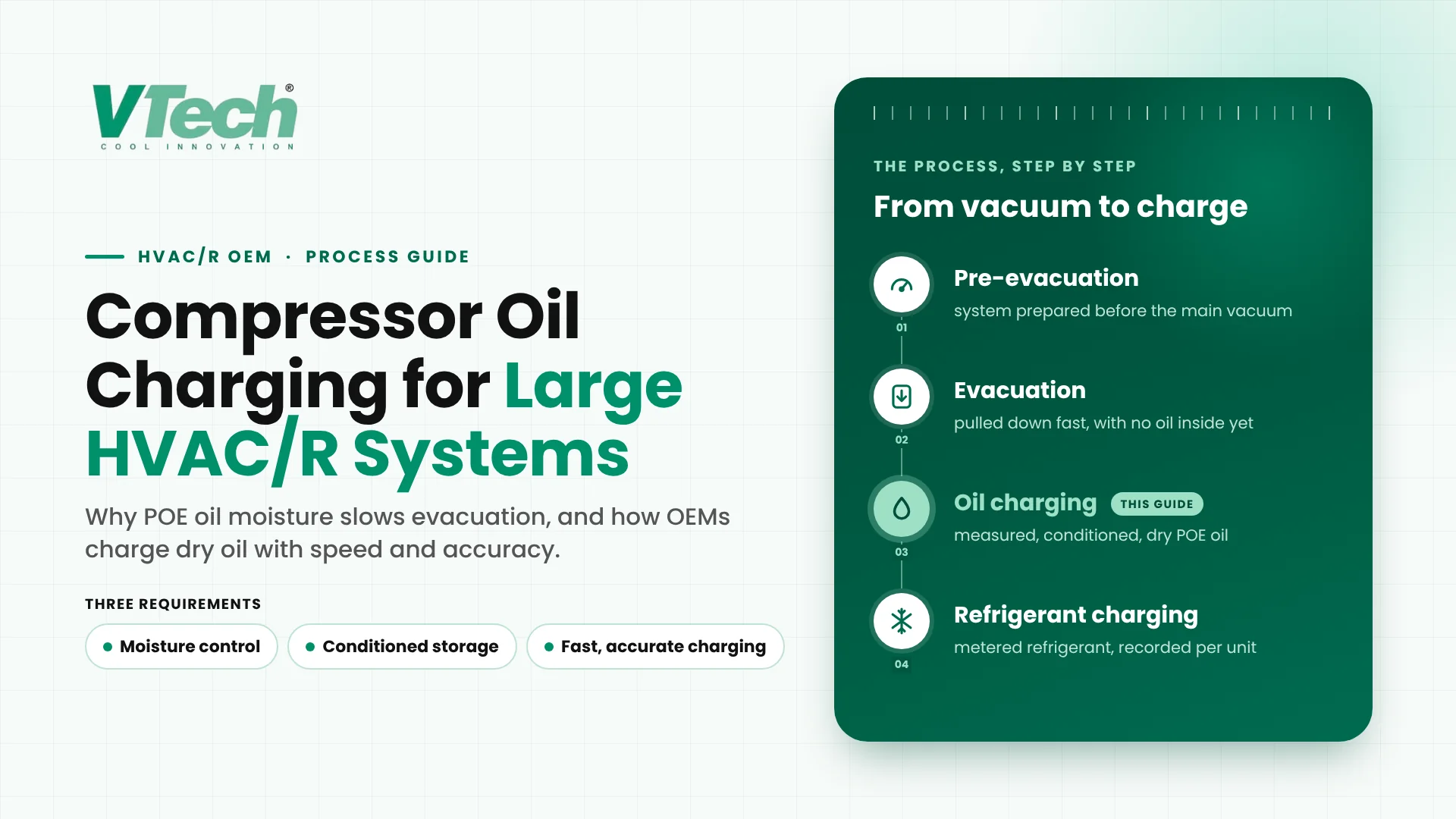
In most appliance manufacturing, compressor oil charging is a non-issue. The vast majority of HVAC/R OEMs receive the refrigerant compressor already charged with oil by its manufacturer, so the production line only has to evacuate the system and charge refrigerant.
Large systems are different. On water chillers for data centers and large commercial air conditioners, some OEMs choose to do their own oil charging as part of the evacuation and refrigerant charging process. The reason is moisture: the oils used with modern refrigerants absorb it readily, and large quantities of oil can turn evacuation into the slowest step on the line.
By the end of this article, you’ll understand why oil charging matters for large HVAC/R systems, what makes it difficult, and the three requirements an efficient compressor oil charging system has to meet.
What is compressor oil charging?
Compressor oil charging is the production step that fills a refrigeration or air-conditioning system with the lubricant its compressor needs. On a production line, it is done under controlled conditions, so the correct quantity of clean, dry oil goes into each system and the result is recorded against the unit’s serial number.
Why large-system OEMs charge compressor oil themselves
For most HVAC/R OEMs, the compressor arrives pre-charged with oil. The oil is already sealed inside, and the line never handles it.
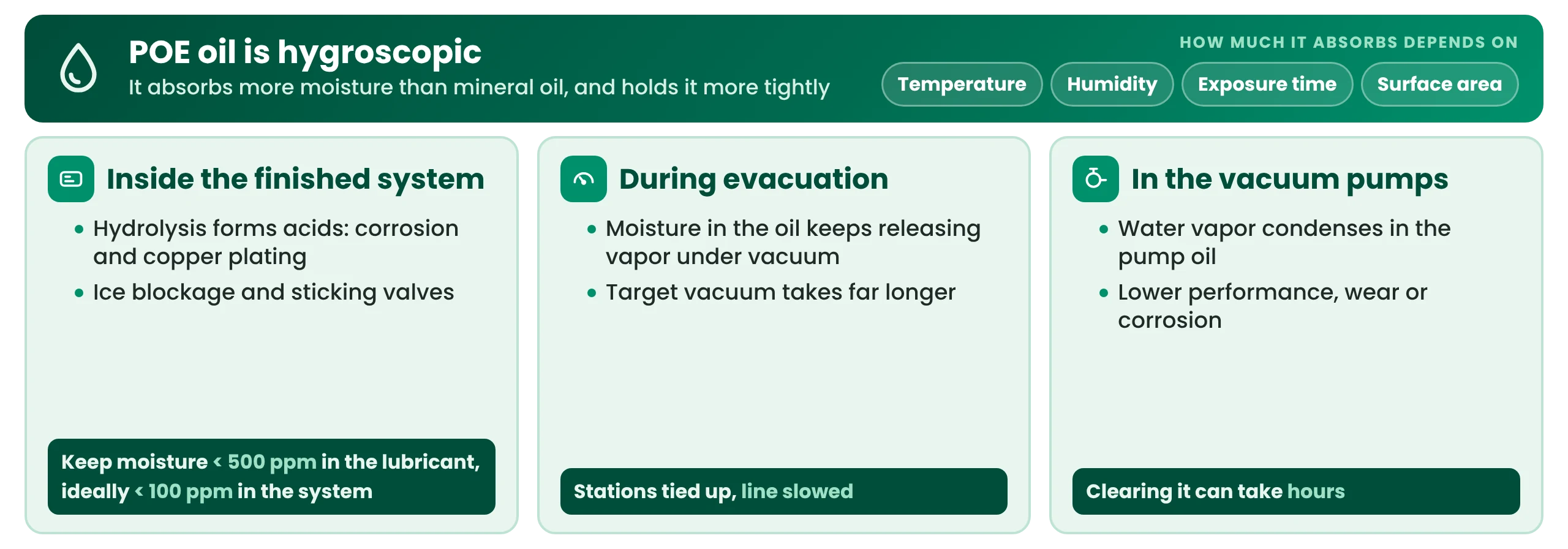
On large systems, the picture changes. A large compressor holds a large quantity of oil, and that oil absorbs moisture. When a system is evacuated with that oil already inside, the moisture in the oil keeps releasing vapor, and evacuation becomes problematic and can take a very long time. The vacuum pumps also take in that moisture, which reduces their pumping efficiency and means they need constant attention.
These are the main reasons some OEMs implement their own oil charging process: evacuate the system first, then charge conditioned oil as part of the evacuation and refrigerant charging sequence.
The core idea: moving oil charging after evacuation takes the moisture problem out of the slowest step on the line, as long as the oil itself is kept dry until it goes in.
Why POE oil moisture makes evacuation difficult
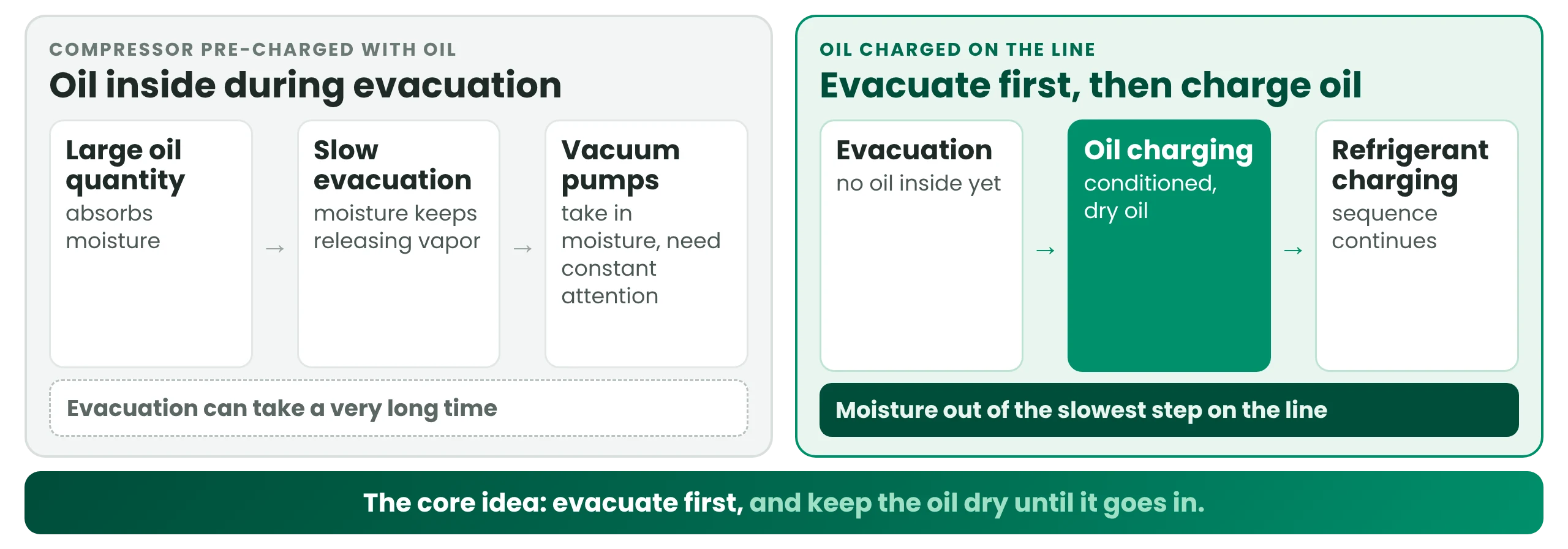
Polyolester (POE) compressor oil is used with A2L and other modern refrigerants. POE oil is hygroscopic: its polar molecules attract water, so it picks up more moisture from its surroundings than mineral oil and holds it more tightly, according to ACHR News. How much it absorbs depends on temperature, humidity, exposure time and the surface area of oil exposed to air.
Inside the finished system
Water can react with the ester in a process called hydrolysis, forming acids that can corrode metals and cause copper plating. Free moisture can also cause ice blockage of expansion devices and sticking valves. Industry guidance recommends keeping moisture below the equivalent of 500 ppm in the lubricant, and preferably below 100 ppm in the system.
During evacuation
When a large quantity of POE oil is already in the system, the moisture it holds keeps releasing vapor under vacuum. Reaching the target vacuum takes far longer, which ties up stations and slows the line.
In the vacuum pumps
In an oil-sealed vacuum pump, water vapor condenses and contaminates the pump oil. That can reduce the pump’s performance and cause damage through loss of lubrication or corrosion. Clearing it, for example by running the pump with its gas ballast open, can take hours.
Where oil charging fits in the production process
In a large-system production environment, oil charging sits between evacuation and refrigerant charging. Evacuating before the oil goes in is what lets the system reach its target vacuum quickly.
→
Evacuation
→
Oil charging
→
Refrigerant charging
→
Testing
For the steps on either side of oil charging, see VTech’s pre-evacuation equipment and our article on multi-refrigerant charging for data center chillers.
Three requirements for an efficient oil charging system
When designing an efficient oil charging system, three main requirements must be kept in mind.
Pre-charged compressors vs oil charging on the line
| Compressor pre-charged with oil | Oil charged on the line | |
|---|---|---|
| Typical use | Most HVAC/R appliances and smaller systems | Some large systems, such as data center chillers and large commercial AC |
| Who handles the oil | The compressor manufacturer | The OEM |
| Evacuation | Oil is already in the system during evacuation | System is evacuated before oil goes in |
| Vacuum pumps | Moisture from large oil quantities can saturate pumps | Less moisture load on the pumps |
| Equipment needed | None for oil | Oil storage, conditioning and charging equipment |
Safety considerations for A2L refrigerants
When oil charging is combined with refrigerant charging, the station handles the refrigerant too. Some large systems now use A2L refrigerants, which are mildly flammable, so the charging equipment and the area around it must be designed for them, from equipment suitability to ventilation and gas detection. VTech’s A2L refrigerant charging systems are engineered for operation with flammable refrigerants including R32, R452 and R454 variants.
Custom compressor oil and refrigerant charging equipment from VTech
VTech Process Equipment designs and manufactures refrigerant management solutions, including custom compressor oil and refrigerant charging equipment for large HVAC/R sealed systems. Systems are custom-engineered around each OEM’s products and production requirements.
Conclusion
For large HVAC/R systems, compressor oil is part of the charge. Keeping it dry, having enough conditioned oil ready, and charging it with speed and accuracy protects both the line’s cycle time and the product’s long-term reliability.
If evacuation is the slowest step on your large-system line, how and when oil goes into the system is worth reviewing early, before investing in more vacuum capacity.
Plan your compressor oil charging process
VTech can help OEMs evaluate compressor oil charging, evacuation and refrigerant charging requirements for large HVAC/R sealed systems.
Frequently asked questions
What is compressor oil charging?
Compressor oil charging is the production step that fills a refrigeration or air-conditioning system with the lubricant its compressor needs, in a measured and recorded quantity.
Why do some HVAC/R OEMs charge compressor oil themselves?
Most OEMs receive compressors already charged with oil. On large systems such as data center chillers, the large quantity of moisture-absorbing oil makes evacuation slow and saturates vacuum pumps, so some OEMs evacuate first and charge conditioned oil as part of the evacuation and refrigerant charging process.
Why is POE oil sensitive to moisture?
POE oil is hygroscopic. Its polar molecules attract water, so it picks up more moisture than mineral oil and holds it more tightly.
How does moisture in compressor oil affect a system?
Water can react with POE oil to form acids that can corrode metals and cause copper plating. Free moisture can also cause ice blockage and sticking valves. Industry guidance recommends below the equivalent of 500 ppm of moisture in the lubricant, and preferably below 100 ppm in the system.
What does an efficient oil charging system need?
Three things: the oil kept in a controlled moisture environment, enough conditioned oil stored to fulfill production requirements, and charging with speed and accuracy.